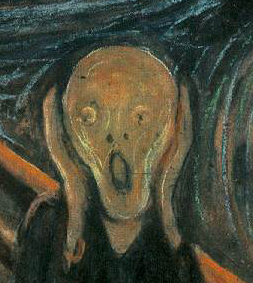
The horror, the horror… lower-rung politician babbling mindless inanity complete with blatantly xenophobic headline! If you feel like wading through the mire please by all means follow the link.
What is one supposed to think when the very call for debate identifies the symbol intended to be the subject of debate as alien? Is this simply an instance of Lukes’ second view of power; the power to set the agenda, or is it more to do with structuralism, the power relationship here is implicitly written within the discourse?
Or is it perhaps just some seriously stupid shit? After much careful analysis and consideration the latter is the only answer I can settle upon. Wonderful constructions such as “where a woman is forced under threat of coercion to wear a burqa” certainly did sway me to this conclusion, the sentiment which sealed the deal was the assertion that
“Much of our social capital is built on those face to face interactions that we have when we pass through a check out while doing our grocery shopping, when we buy a coffee in the morning or when we take our children to the playground and have a chat to other mums and dads there.”
Oh fuck.
Well where to start the analysis here? I am temped foremost to take a structuralist approach purely because of the contorted grammar. One can perhaps assume that such bizarre constructions imply that the author is being dishonest with us, or at least “veiling” the intent of their language. For instance the first sample: is one forced or coerced? Threatening further complicates issues. Threats I understand, may imply coercion but force seems to render both threats and coercion superfluous. Maybe the vagueness is because one can’t really slander the imaginary hordes of burqa wearing women the author seeks to conjure because that would appear to be overtly denigrating other women’s choices, culture, and that.
This brings us screaming to the second sample. I guess, given that we live in rational modernity, rational choice being our sacred mantra, to effectively argue that the imagined burqa community is shit we will need an alternative imagined community to rationally choose instead. In order to facilitate a rational choice for our own way of life Ms Cash presents some concoction about checkouts, coffee counters, and playgrounds. Undoubtedly many of us are found in these social spaces, the implications to be drawn from this are unclear.
The immediate body of work which springs to mind regarding the socio-political implications of the everyday is Orwell’s. His studies of the everyday are replete with instances that delve into the mutual hatreds and resentments, codified in formalized behaviours for serving and being served which accompany the performance of face to face commerce. That he wrote before the advent of industrialized shopping in the form of grocery checkouts only serves to heighten the point that such social interaction is a throwback to a cultural epoch which predates the unfettered market. To extend Ms Cash’s argument are we to imagine that the great supermarket interest’s codes of conduct for customer service constitute the heart of Australian cultural values? More importantly, what are we then to make of the push for automated checkouts? Stepping sideways, why do I feel so confronted and uncomfortable when the tellers at the Commonwealth bank ask me about my day in line with their new customer service initiatives? While it is true I suffer from paranoia, who the fuck are you to ask after my wellbeing and address me by my Christian name?
I digress, I am ranting…
Fundamentally the premise that Australia’s actual or imagined community is fundamentally predicated on clean faced interaction in social spaces either constructed by or established for commerce is questionable.
The playground scene is fundamentally problematic; the analysis of a social spatiality wedded to the concept of “play” is a sociological nightmare I do not wish to examine here. I probably don’t have to either because it is reasonably clear that the implication of the article is that burqa clad women are not welcome at authentic Australian playgrounds. This is the fundamentally interesting premise of the entire article. It is implied that facial visibility is an essential basis for participation in Australian society. Interestingly Ms Cash seems to imply that because one cannot see the face of a burqa alien they have no individuality, they are incapable of participating because they cannot be heard or interact effectively.
On the contrary it might be argued, particularly in the Australian context, that the visibility of the burqa is the key problem. Worse still the implied or decoded message issued forth by burqa wearers – or at the very least the message decoded for us by Ms Cash - is that conformity to the trends of the aforementioned western modernity is not the only possibility in terms of getting through this life. So reconfigured, the real problem with having hordes of burqa clad women ambling about our streets is that they serve to foster a constant questioning, an endless debate, a nagging doubt that the Australian identity supplied for us in the interactions of the checkout line, coffee counter, playground troika is not as fixed and settled as we may imagine.
the colonial

No comments:
Post a Comment